Projects
A small collection of projects I’ve enjoyed.
Deep Learning–Based Driving Simulation
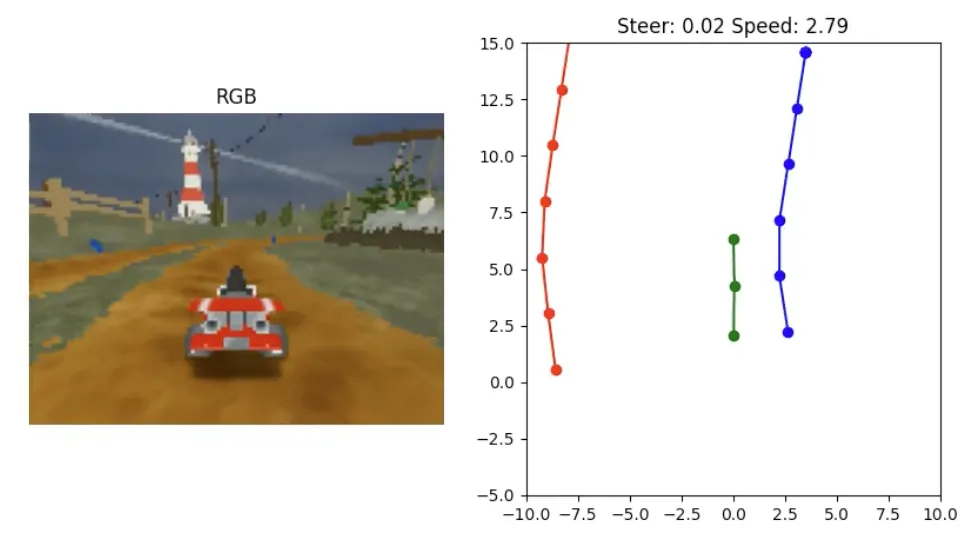
I built a driving agent that predicts short-horizon waypoint trajectories and drives in a closed-loop simulated racing environment. Rather than outputting steering commands directly, the model regresses future waypoints in vehicle coordinates, which are then tracked by a controller to generate steering and throttle. This formula turns driving into a multi-step planning problem instead of a single-step control task.
On the modeling side, I trained a CNN-based planner with a MobileNetV2 encoder and a lightweight MLP head that outputs n_waypoints × 2 coordinates directly from RGB frames. I also implemented an attention-based planner using a TransformerDecoder with learned waypoint query embeddings that cross-attend to encoded lane boundary points, as well as a compact MLP planner that maps concatenated left and right lane boundaries to future trajectories. Training used a masked L1 loss over valid waypoints, with longitudinal and lateral error tracked as offline planning metrics.
Running the models in closed loop surfaced the kinds of issues that don’t appear in static prediction tasks. Because predicted trajectories are executed and fed back into the system, small errors compound over time, occasionally leading to instability or failure (as seen near the end of the demo video).
https://youtu.be/rPha2L8GoAM?si=a4zyLBjPGi7MBAWh
Notable Undergrad Data Science Work
Partnering with the Office of Institutional Research & Effectiveness
I modeled and presented strategies for increasing retention rates for the purposes of national ranking. Using student data and surveys, I found that reliance on informal advisors negatively predicted retention. Findings helped justify hiring full-time professional advisors for first-years and undeclared students.
Partnering with a global tech OEM
I modeled in-transit lead times to advise shipping strategy. Using order data I found that ship mode proved the biggest lever in variance. Scenario testing showed that blending faster lanes with cheaper modes could shave several days on urgent shipments without busting freight budgets.
Partnering with the Office of Admissions
I predicted if an admitted student would enroll and why. Using application data from 15,000 admits, I found early-decision status, top-percent-in-class, campus visits, and recruiter engagement were among the most influential variables.